
The Neuroscience of Change
Without Resistance
How Limbic Friction, Self-Discipline, and the Brain’s Tenacity Network Can Help Leaders Accelerate Enterprise Transformation
Imagine
An enterprise where people don’t wait to be told what needs to change.
- Where difficult challenges create curiosity, not defensiveness.
- Where change doesn’t depend on endless campaigns and executive intervention.
- Where transformation gains momentum because people move it forward themselves.
Here is the science of how to build it.


The strategy is sound. Progress is slow.
The strategy is sound. The roadmap is detailed. Leadership is aligned. The investment has been approved.
Yet transformation is moving far slower than expected.
New processes arrive, but adoption is inconsistent. Employees attend training, then return to familiar behaviors. Leaders agree that change is necessary, yet keep doing things the way they’ve always done them.
So organizations respond with more communication, more training, more governance, and more accountability.
And still, progress is painfully slow.
What if the biggest obstacle to enterprise transformation isn’t strategy, capability, or even willingness to change? What if it’s the mental and physiological effort required to change behavior?
Neuroscience offers a useful perspective here. Recent research into motivation, effort, self-discipline, and the brain’s capacity for tenacity points toward a different way of thinking about organizational change. The objective isn’t to push people harder. It’s to help them become more capable of embracing challenges, working through resistance, and taking ownership of their own growth.
That changes how we should approach enterprise transformation.
Tools don’t automatically create motivation.
Most enterprise transformation programs focus on what people need to do. They define a strategy, redesign processes, implement technology, establish governance, and deliver training. Where the answer is known, as in a system migration or a compliance requirement, that is the right approach.
Employees receive training on value-based pricing. New tools are deployed. Managers receive dashboards to monitor compliance.
Commercial teams keep discounting.
Why?
Perhaps they’re uncomfortable defending higher prices. Perhaps they fear losing customers. Perhaps they don’t believe the new approach will work. Or perhaps they’re uncertain whether leadership will support them when negotiations get difficult.
The challenge isn’t necessarily a lack of knowledge. It’s the perceived risk and effort of changing behavior.
More training alone won’t resolve that, and neither will another dashboard.

The challenge is rarely a lack of knowledge. It is the perceived risk and effort of changing.
Some resistance is information.
Not all resistance is psychological, of course. People may have legitimate concerns about flawed processes, contradictory incentives, unrealistic workloads, or poor strategic decisions.
Flawed processes
When the process makes the right behavior hard, pushing back is a reasonable response.
Contradictory incentives
When pay and scorecards reward the old way, the new way loses before it ever gets started.
Unrealistic workloads
When there is no capacity for the change, resistance is a fair response, not a flaw.
Poor strategic decisions
When the strategy itself is wrong, resistance tells leaders so before the results do.
Leadership needs to address those barriers directly. The best place to find them is with the people closest to the work, before anyone designs the solution.
Treating every adoption challenge as a failure of communication, training, or accountability overlooks the human factors that shape whether people take action.
Compliance can be mandated. Commitment has to be developed.
That requires a different approach.

Some resistance is information. Leaders who listen to it build commitment, not just compliance.
The barrier sits below the surface.
Most transformation effort goes in above the waterline. That work is visible, funded, and necessary, but it does not decide whether people change how they work. What decides that sits below the surface, where leaders rarely look.
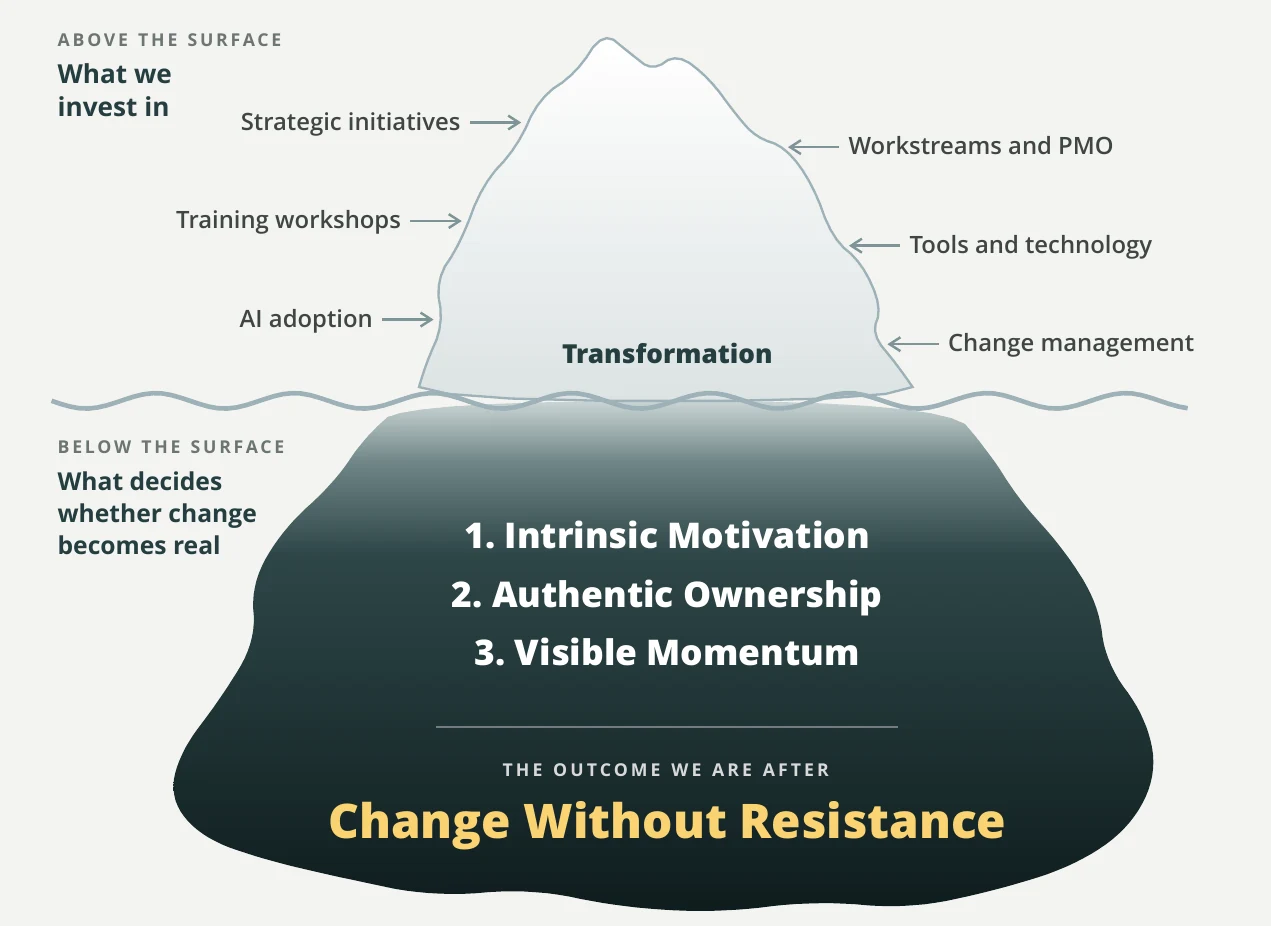
Activity and investment do not automatically create ownership or impact.
Friction sits between intention and action.
Neuroscientist Dr. Andrew Huberman introduced a term that helps explain why people struggle to act even when they know what they should do. He calls it limbic friction: the internal effort required to overcome a mental or physiological state that makes a desired behavior difficult to start.
The internal effort required to overcome a mental or physiological state that makes a desired behavior difficult to start.
Think about getting out of bed early to exercise. You know it’s beneficial, and you’ve committed to doing it. Yet when the alarm goes off, everything in your body seems to argue against getting up.
That’s limbic friction. It can arise when we’re tired, unmotivated, or comfortable, and when we’re stressed, anxious, or overwhelmed. Either way, there’s a gap between what we intend to do and what we do.
Now consider a large enterprise asking thousands of employees to adopt a new commercial strategy, change how they manage customers, embrace AI, or take greater accountability for results. Each change asks people to interrupt established behaviors, face uncertainty, and invest effort in something unfamiliar.
What looks like organizational resistance may partly reflect thousands of individual experiences of behavioral friction. And the more effortful change feels, the harder it becomes to build momentum.
Knowing what to do and doing it are two very different things.
Hear the science from Dr. Andrew Huberman.

Dr. Andrew Huberman
Neuroscientist and host of the Huberman Lab podcast
Two of his episodes cover the science in this article.
Photo: Huberman Lab (cropped).
The Science of Making and Breaking Habits
Where he introduces limbic friction and the effort it takes to start a behavior.
- Limbic friction in his words: the strain needed to overcome a body state that is too alert or too tired
- Why building a new habit takes more of it at first
- His advice: put the hardest habits early, when the brain is most action-oriented
How to Increase Your Willpower & Tenacity
The anterior midcingulate cortex, tenacity, and why choosing hard things you would rather avoid matters.
- The aMCC as a willpower hub that pushes you to act or to resist an urge
- Why small, uncomfortable challenges, which he calls micro sucks, engage it
- The research behind it: the Cortex paper on the tenacious brain
Both ideas matter at work. The cost of starting explains why a clear strategy still meets hesitation, and the value of choosing hard things explains how tenacity gets built. The rest of this article turns them into practice.

The strategy is sound. The hard part is the friction between intention and action.
Self-discipline: acting despite friction.
So how do we overcome limbic friction? One answer is self-discipline. It lets us keep goal-directed behavior going even when our emotional state pushes us to avoid it.
You don’t need to feel motivated to exercise.
You need to get started.
You don’t need to feel comfortable having a difficult conversation.
You need to recognize its importance and begin it.
You don’t need to enjoy each part of learning a new capability.
You need to persist long enough to become competent.
Difficulty is not always something the brain wants to avoid. Sometimes effort itself becomes rewarding. In their research review, The Effort Paradox: Effort Is Both Costly and Valued, Michael Inzlicht, Amitai Shenhav, and Christopher Olivola describe how people can form positive associations with effort.
Instead of treating every difficult assignment as a burden to endure, leaders can create experiences where effort leads to progress, progress builds confidence, and confidence makes people willing to take on the next challenge.
Self-discipline has limits. You can force yourself through an uncomfortable workout, but willpower and executive pressure rarely sustain 20,000 employees through years of transformation.
Self-discipline bridges the gap between intention and action.
The brain weighs effort against reward.
One of the most interesting developments is the anterior midcingulate cortex, or aMCC, a brain region that helps evaluate effort, motivation, and the resources difficult goals require.
In a 2020 neuroscience review, Alexandra Touroutoglou and colleagues examined evidence that the aMCC acts as an important network hub for tenacity: our capacity to persist in the face of challenges. It integrates information from several brain systems to weigh the potential reward of acting, the effort required, and the resources to see it through.
Consider two people facing exactly the same difficult assignment.
An exhausting obligation with uncertain rewards.
A chance to learn something valuable, demonstrate capability, and achieve a meaningful outcome.
The challenge is identical. The perceived value of the effort is different. That difference can decide whether someone engages, persists, or withdraws. When people see change mainly as a threat or one more burden, the effort it takes may outweigh the value they expect to get. When they see a chance to grow, contribute, and achieve something that matters, their willingness to invest effort rises.
Motivation and persistence depend on how the brain weighs effort, resources, and expected reward. How a change is framed, what it costs to try, and what support is in reach all shape that sum.
Leaders have a hand in how effort is weighed against reward.
The aMCC sits deep on the brain’s midline.
The aMCC sits deep on the midline of the brain, in the cingulate cortex just above the corpus callosum, the band of fibers that connects the two hemispheres. It is the front part of the midcingulate cortex. Taking on challenges that test your willpower builds perseverance and the capacity for self-control.
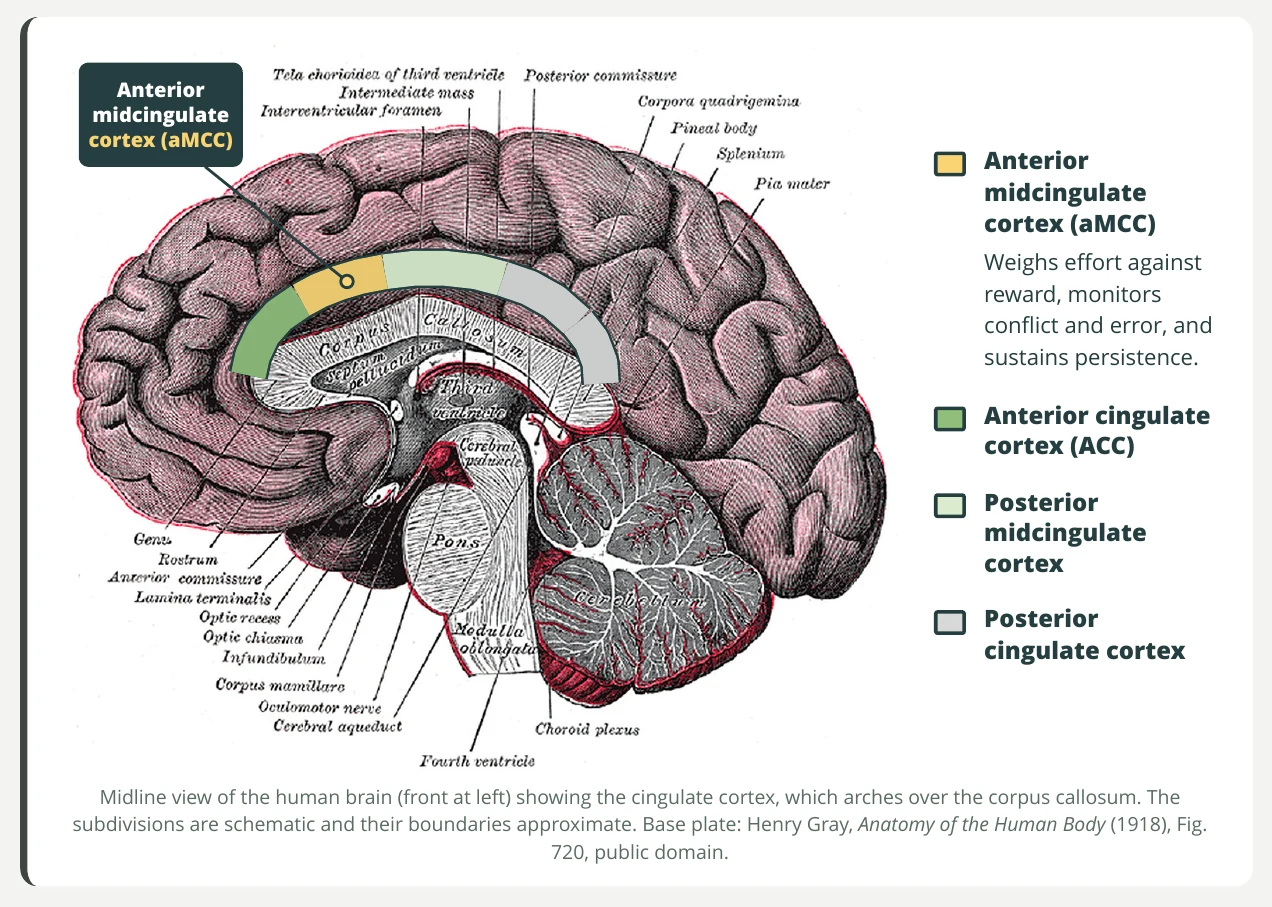
It is where discomfort turns into growth and effort into mastery.
The scientist behind AQ® and GRIT™.
Dr. Paul Stoltz
Ph.D. scientist, Founder & CEO, PEAK Learning

Dr. Paul Stoltz created Adversity Quotient (AQ®) and the GRIT™ framework, and founded PEAK Learning. He is the author of Adversity Quotient: Turning Obstacles into Opportunities, Adversity Quotient @ Work, and GRIT: The New Science of What It Takes to Persevere, Flourish, Succeed.
AQ® and GRIT™ are performance science, built on more than four decades of Paul’s work and on research across more than 3,500 studies at over 100 universities.
- Master Coach for the USA Olympic Team
- Ph.D. scientist and creator of AQ® and GRIT™
- Guest faculty at Stanford, Princeton and INSEAD
- His science is used in Harvard Business School’s MBA program and MIT’s Entrepreneurship program
- He has advised Apple, Amazon, P&G, Google and many other Fortune 500 leadership teams
Hear Dr. Stoltz describe AQ® and GRIT™ in his own words: Harnessing Adversity with Dr. Paul Stoltz, on the Commercial Excellence Consortium podcast.
Performance science built on four decades of work, 3,500+ studies, 100+ universities.
AQ® goes beyond resilience.
For decades, research has shown that IQ predicts very little about wealth, success, happiness, or performance. Dr. Paul Stoltz went looking for what does. He found a hidden element: what people do with the tough stuff. If there is a thing called an IQ, he reasoned, there should be something called an AQ®.
Adversity Quotient (AQ®) is your hardwired pattern of response to adversity. It has become what Dr. Stoltz calls the global gold standard for two things: measuring how people respond to adversity, and a method for permanently upgrading how they deal with it.
AQ® goes beyond resilience. Ask a room what a resilient person does and the answer comes back in chorus: bounce back. But if you bounce back from adversity thirty-six times a day, what is missing? Any learning or growth. AQ® aims at what Dr. Stoltz calls response ability: the ability to respond optimally to whatever happens, the moment it strikes.
A six-minute assessment, built and refined over four decades with many of the world’s top universities, and proven to be predictive and reliable.
Groups that go through an AQ® experience improve by 11 to 23 percent on average.
In teams assessed over ten years, Dr. Stoltz reports, AQ® that went up was never seen to go down.
AQ® is a skill, not a personality trait. You can measure it and improve it permanently.
Climbers, campers, and quitters.
Dr. Stoltz describes three ways people meet a hard climb. Quitters step away from it. Campers climb part of the way, find a safe spot, and settle. Climbers keep moving up, whatever the terrain.
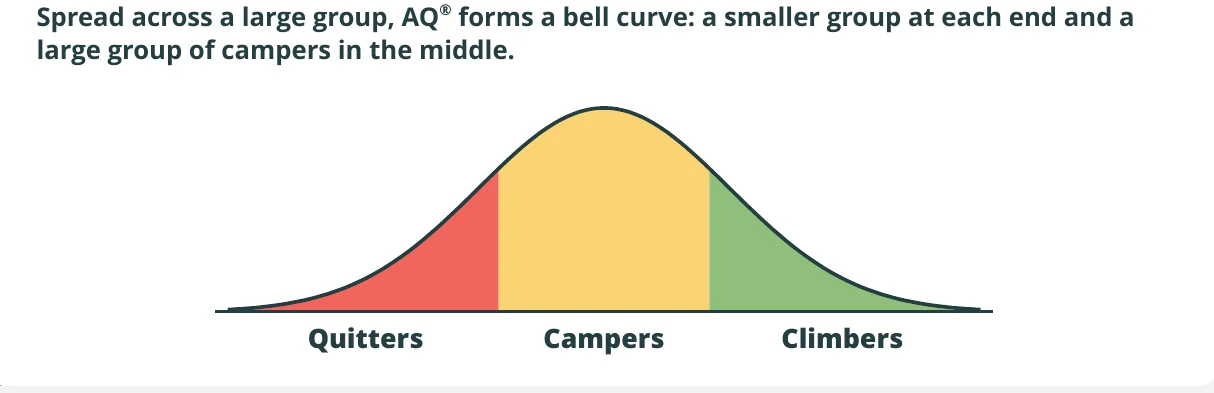
A transformation lands on all three at once. Climbers run toward it. Quitters push against it. Campers, the largest group, decide by how the change is framed, what it costs to try, and what support is in reach.
In Dr. Stoltz’s research, people with higher AQ® outperform people with lower AQ® in sales, engagement, retention, productivity, and innovation.
The curve can be shifted. Because AQ® is a skill, it can be measured and strengthened, which gives campers a way back onto the climb.
See it in practice: the LANXESS case study, or the proof case on the Fellowship page.
Most of the people a change needs are campers, and AQ® is a skill they can build.
AQ® in, GRIT™ out, the aMCC in between.
The aMCC doesn’t work alone. The research behind AQ® and GRIT™ describes the two ends of the same process: how people read a difficult situation, and how they keep going once they’ve decided it’s worth the effort.
GRIT™ is your capacity to dig deep for what matters most. It combines growth, resilience, instinct, and tenacity: doing whatever it takes, in the right ways, to achieve what matters.
The aMCC sits between them. AQ® shapes how a challenge is interpreted. The aMCC integrates value, cost, and capacity, and mobilizes effort. GRIT™ sustains that effort. Each effort that works builds confidence and resilience, which changes the next appraisal.
That is a loop, not a trait.
- 1AdversityA challenge or setback arrives.
- 2AppraisalAQ®Threat or opportunity; control and agency.
- 3EffortaMCCValue, cost and capacity weighed; effort mobilized.
- 4ActionGRIT™Persist, adapt and keep going.
- 5GrowthProgress builds confidence and capability.
AQ® shapes the appraisal. GRIT™ sustains the effort.
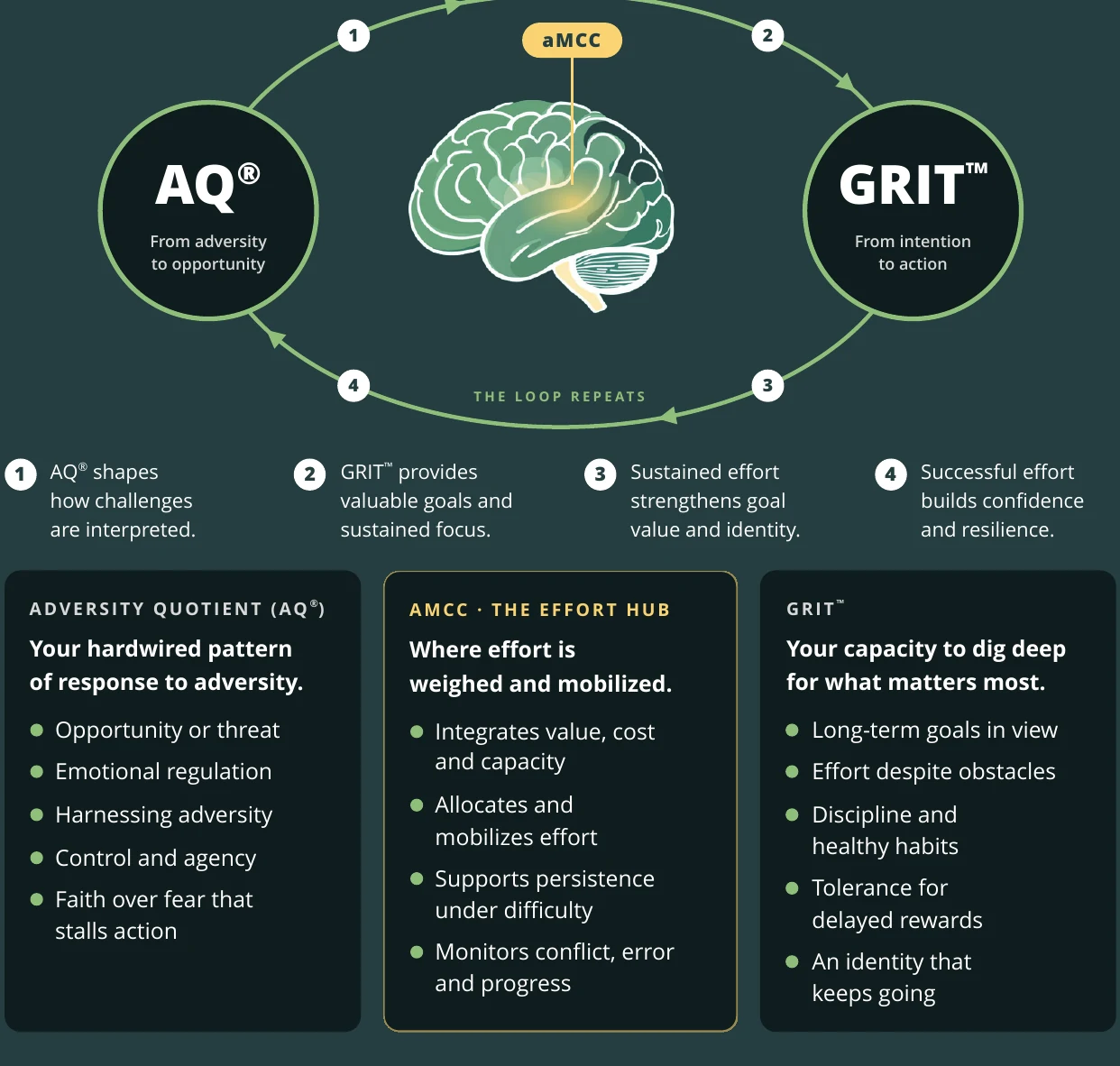
How the loop strengthens the aMCC.
The aMCC weighs effort against reward and decides how much of yourself to commit. AQ® shapes what it weighs: whether a challenge reads as a threat or an opportunity, and whether it feels controllable. GRIT™ supplies the follow-through: the goals, the persistence, and the habit of continuing.
The research points the same way. In a 2020 review, greater aMCC volume predicted persistence, and the region grew more active as tasks got harder. The authors raise an intriguing possibility: that its structure and function could be altered with sufficient behavioral training.
- A challenge reads as an opportunity, so the aMCC mobilizes effort.
- The effort works and confidence builds.
The next start costs less.
- A challenge reads as a threat, so the effort is avoided.
- The network gets little practice and confidence does not build.
The next start costs more.
Think of the aMCC as a muscle. That is a way of thinking, not a measurement: the research does not yet show that avoiding hard things weakens it.
Effort and the capacity for effort grow together.

Adversity becomes action through one loop: AQ®, the aMCC, then GRIT™.
Make discipline less necessary.
Here’s something counterintuitive. People with strong self-control aren’t necessarily spending their days fighting harder against temptation. They’re often better at setting up routines and habits that make the right behavior easier.
Psychologists Brian Galla and Angela Duckworth explored this in six studies involving 2,274 participants. Their findings suggest that beneficial habits help explain why people with greater self-control achieve better outcomes while feeling less motivational conflict.
Think about someone who has exercised consistently for years. In the beginning, every workout took deliberate effort. Eventually, exercise became part of the routine. They don’t debate it each morning. They do it, and the behavior becomes more automatic. Research by Phillippa Lally and colleagues shows that habit formation depends on repeated behavior in a consistent context, with wide variation in how long automaticity takes.
The purpose of self-discipline isn’t to spend your life forcing yourself to do difficult things. It’s to establish behaviors that need less and less conscious effort.
That applies directly to enterprise transformation. The goal shouldn’t be employees who need constant encouragement, supervision, or pressure to adopt new ways of working. The goal should be people who increasingly take initiative, embrace challenges, and improve how they work without waiting to be told.
That’s a very different ambition.
How a new behavior becomes automatic
- 1The beginningAnything new takes deliberate effort.
- 2RepetitionThe same behavior, repeated in a consistent context.
- 3The routineIt takes less and less conscious effort.
Establish behaviors that need less and less conscious effort.

So how do we make change easier?
Three levers help people want it, do it, and show it is working.
From self-discipline to adaptability.
Put the three levers together and something important becomes possible. Structured Autonomy gives people greater influence over their actions. Harnessed Adversity helps them meet difficult challenges with greater resilience. Coached Capability gives them the tools, practice, and confidence to succeed.
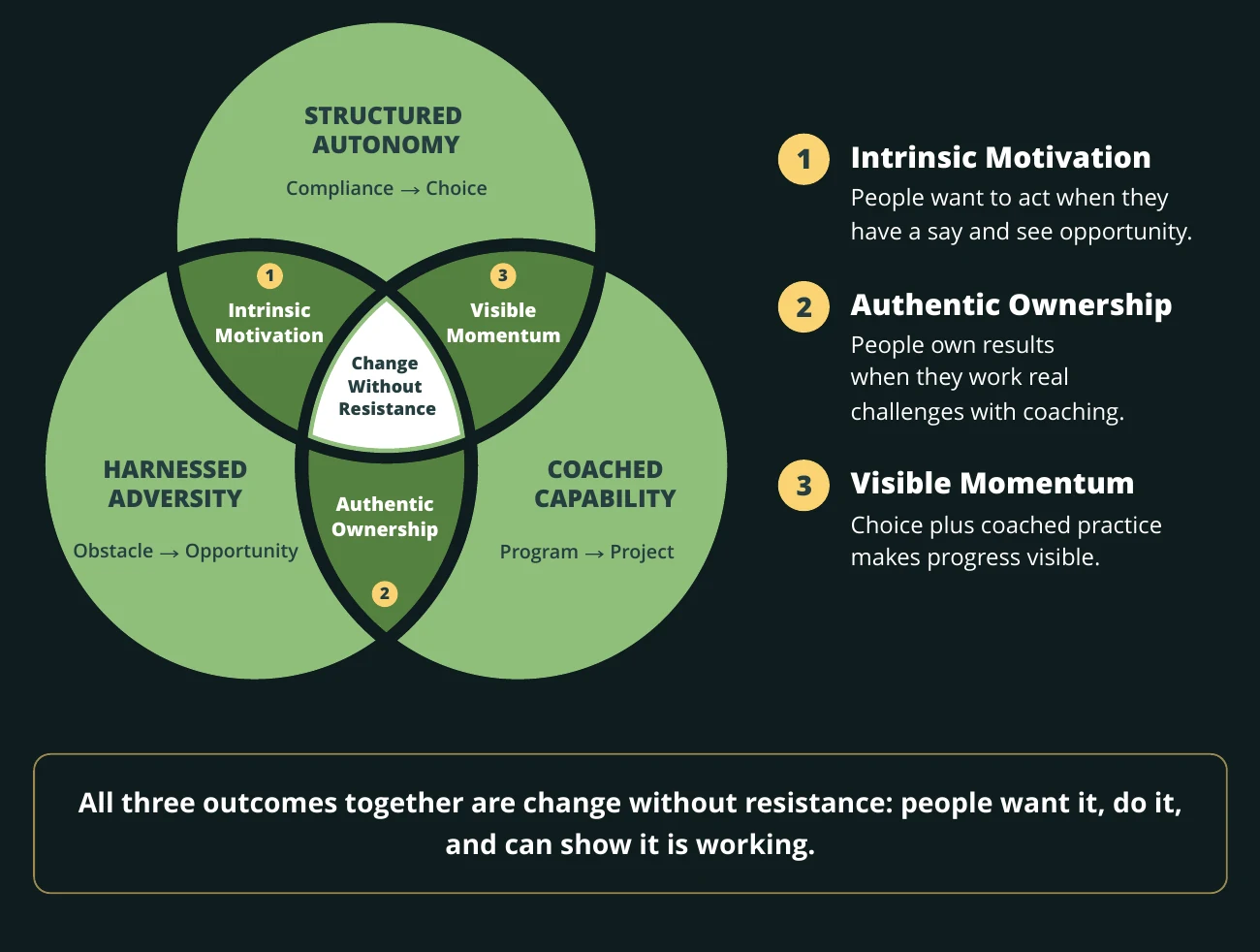
How the levers drive the outcomes
- Structured Autonomy + Harnessed Adversity → Intrinsic Motivation. People want to act when they have a say and see opportunity.
- Coached Capability + Harnessed Adversity → Authentic Ownership. People own results when they work real challenges with coaching.
- Structured Autonomy + Coached Capability → Visible Momentum. Choice plus coached practice makes progress visible.
All three outcomes together are change without resistance: people want it, do it, and can show it is working.
1 · Structured Autonomy: from compliance to choice
People are more likely to commit to a course of action when they have meaningful influence over how they pursue it. This fits Self-Determination Theory, from psychologists Edward Deci and Richard Ryan, whose research on workplace motivation identifies autonomy, competence, and relatedness as fundamental psychological needs.
Yet many programs undermine autonomy without meaning to: leadership defines what must change, how, and when.
Leaders set clear priorities, boundaries, and expected outcomes, and keep what only leadership can own: the problem worth solving, the real constraints, and how we judge success. Inside those boundaries, people choose how to contribute and help diagnose what is getting in the way. Delegation hands over a task. Structured Autonomy hands over a share of the problem.
This is how Structured Autonomy builds Intrinsic Motivation. When people have chosen how to approach the work, the effort stops being someone else’s instruction. They are working on their own answer to a problem they helped define, so the reason to act comes from inside. That wanting runs deepest when the challenge ahead looks worth taking on.
The objective is authentic ownership, not reluctant compliance.
How can we reduce defensiveness from the people we are serving?
Paradigm shift 1: Don’t force compliance. Give people choices.
2 · Harnessed Adversity: from obstacle to opportunity
When adversity reads as a threat, people may become defensive, disengaged, or avoidant. When they believe they can influence outcomes and grow through difficulty, they are more willing to engage.
Harnessed Adversity means helping people build the resilience, adaptability, and tenacity to approach difficult situations constructively, with meaningful challenges, appropriate support, and chances to experience progress. It doesn’t mean celebrating unnecessary suffering or tolerating unreasonable workloads.
We can’t remove the effort unfamiliar challenges demand, but we can help people see its value and that they can succeed. Adversity becomes something people work with, rather than something they automatically resist.
This is how Harnessed Adversity builds Authentic Ownership. People take ownership of a result when they have struggled with it and come through. Someone who has worked through a real obstacle, with support and a visible way forward, stops treating the problem as someone else’s to solve and starts owning the outcome.
How can we get people unstuck and focused on solutions?
Paradigm shift 2: Reframe obstacles as opportunities for growth.
3 · Coached Capability: from program to project
People rarely develop lasting capabilities by attending training. They develop them by applying what they’ve learned, working through difficulties, receiving feedback, and improving with practice.
This is where traditional corporate learning loses momentum: employees attend workshops, earn certificates, then return to familiar routines.
Coached Capability changes that. The shift is from delivering training programs to coaching teams on projects. People take on real work on real projects they have chosen themselves, with an experienced coach beside them to help them work through obstacles, test ideas, make decisions, and improve performance. We call them Growth Projects™. The real work is the mechanism: it is where the capability gets built.
That builds competence and confidence, and the next challenge feels more manageable. Over time the organization gets better at adapting, because its people repeatedly learn by doing.
This is how Coached Capability builds Visible Momentum. With a coach beside them on real work, progress shows up in the work itself: a decision made, an obstacle cleared, a result others can see. Each win is evidence that the effort is paying off, so momentum becomes visible to the team and its leaders.
How can we upskill our people to rapidly respond to challenges?
Paradigm shift 3: Stop delivering training programs. Start coaching teams on projects.
Three levers, three outcomes, change without resistance.
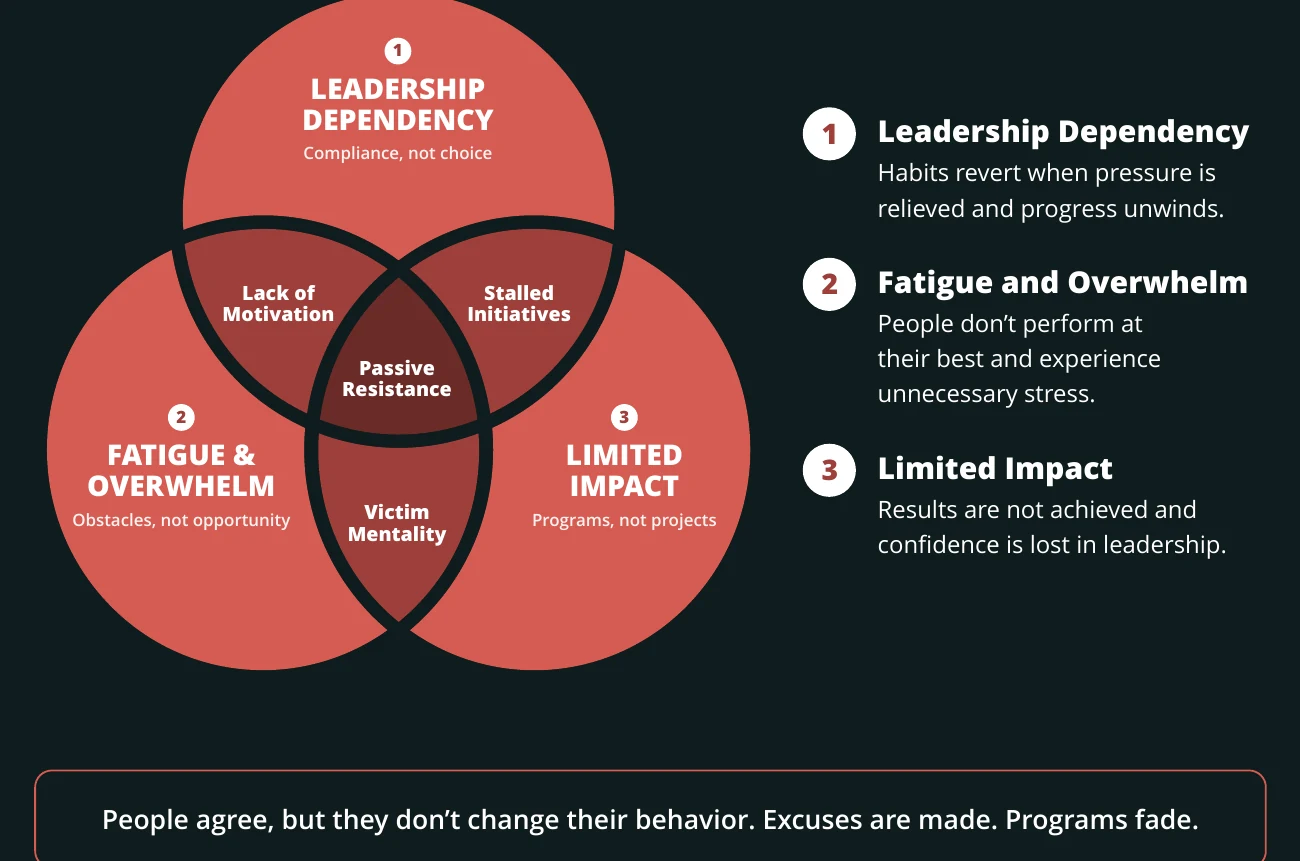
When change is pushed: passive resistance.
When change is pushed from the top, it runs on compliance instead of choice, obstacles instead of opportunity, and programs instead of projects. The result is passive resistance: people nod and agree in the meeting, then go back to what they were doing the next day.
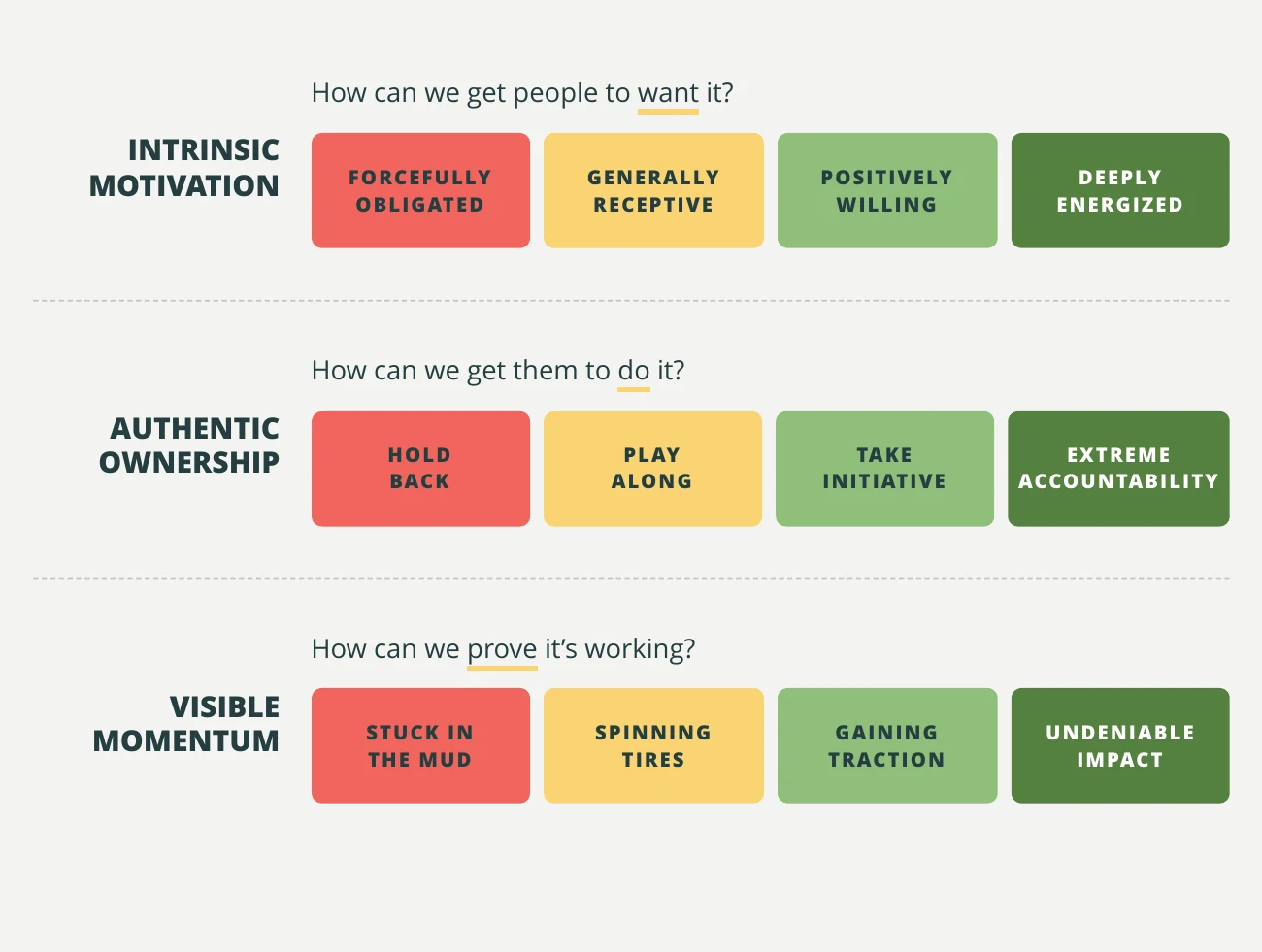
Where does your organization stand?
Think about your own organization. For each of the three outcomes below, where are your people today? Pick the box that sounds most like the people carrying out your current change, then see how far it is from the one on the right.
Strategy becomes behavior in a cycle.
One way to move from strategic priorities to sustained changes in behavior is a repeating cycle: align, inspire, reflect, apply, and scale. It doesn’t assume that understanding a strategy produces action.
- Align
Design & Pre‑Work
- Executive sponsorship
- Define challenges
- Prioritize capabilities
- Select pilot region/unit
- Inspire
Participant Assignment
- Assess baseline AQ® / GRIT™
- See what ‘good’ looks like
- Get input from team
- Isolate perceived issues
- Reflect
On‑Site Workshop
- Understand barriers
- Psychological safety
- Define Growth Projects™
- Commit to the work
- Apply
On‑The‑Job Coaching
- Support project teams
- Build practical skills
- Develop mental toughness
- Measure KPIs & results
- Scale
Report to Leadership
- Demonstrate impact
- Make recommendations
- Resolve structural barriers
- Scale up successes
The idea is not to deliver a “program”.
It is to build new capabilities, solve issues, and impact results. Immediately.
How do we get employees to comply with our transformation agenda?
How do we create the conditions where employees want to advance it themselves?
That is the difference between managing resistance and developing adaptability.
The real measure of success is performance.
None of this matters unless it produces better business results. Large enterprises don’t invest in transformation to create happier employees or higher attendance at training. They need measurable gains in revenue growth, profitability, productivity, customer retention, and competitive performance.
Are employees becoming more resilient and capable of handling adversity?
Are they taking greater initiative?
Are new behaviors being adopted and sustained?
Are the projects generating measurable commercial improvements?
The AQ® and GRIT™ assessments, developed by Dr. Paul Stoltz and PEAK Learning, help evaluate adaptability, resilience, and persistence. Pair them with observable behavior and financial results.
The goal is to connect human development to commercial performance. When people become more capable of adapting, organizations respond faster to market changes, execute more effectively, and turn strategy into financial impact sooner.
Connect human development to commercial performance.

Motivation, ownership and momentum: that is change without resistance.
The possibility: change without resistance.
Imagine a different kind of enterprise. One where employees don’t wait for leadership to tell them what needs to change. Where difficult challenges create curiosity and initiative rather than automatic defensiveness. Where people take pride in developing new capabilities. Where change doesn’t depend on endless communication campaigns, compliance checks, and executive intervention. And where transformation gains momentum because people are motivated and equipped to move it forward themselves.
That’s the possibility behind change without resistance. It doesn’t mean eliminating discomfort, disagreement, or every legitimate obstacle. Those are inevitable. It means reducing unnecessary friction and developing people who are increasingly willing and able to work through the challenges that remain.
Self-discipline helps us act despite resistance. Neuroscience helps explain why effort and persistence matter. Motivational psychology shows how autonomy and competence support commitment. Deliberate practice turns unfamiliar behaviors into lasting capabilities.
Together, these ideas point toward a better approach to enterprise transformation. Stop relying on people to keep overcoming resistance.
Start building organizations where adapting is a natural part of how people work.
Learn to drive change without resistance.
An eight-week accelerator cohort for transformation leaders facing passive resistance, low ownership and change fatigue.
- Eight weekly live sessions led by Jesse Hopps and John Follett
- A live session with Dr. Paul Stoltz on AQ® and GRIT™
- TransformationOS™ and the AIRAS method, with Roy van Griensven
- A confidential cohort of 20 senior leaders, no direct competitors, under a mutual NDA
- You build and present your own Transformation Acceleration Blueprint
The first cohort starts in the second week of January 2027 and runs to early March. Applications close December 31, 2026.
The future belongs to enterprises that can adapt faster than the world around them. Learn how to build one.
Written by two people who study how change takes hold.
Prefer the designed edition?The same article as a 34-page brief you can page through or save.
Jesse Hopps
Founder, Philosopher, Author, Coach

Jesse founded Demand Metric in 2006 and built it into a library of research, playbooks and tools used by 6,589 companies in 108 countries. He founded the Commercial Excellence Consortium so senior leaders had a place to compare notes, and he is the architect of TransformationOS™. He studied philosophy, is writing The Transformation Architect, and lives with his wife and two daughters in Medellín, Colombia.
Dr. Paul Stoltz
Ph.D. scientist, Founder & CEO, PEAK Learning
Dr. Paul Stoltz is Master Coach for the USA Olympic Team, a Ph.D. scientist, and the creator of Adversity Quotient (AQ®) and the GRIT™ framework. He founded PEAK Learning. He is guest faculty at Stanford, Princeton and INSEAD, and his science is used in Harvard Business School’s MBA program and MIT’s Entrepreneurship program. He has advised Apple, Amazon, P&G, Google and many other Fortune 500 leadership teams.
- Dr. Paul Stoltz. Harnessing Adversity with Dr. Paul Stoltz (Commercial Excellence Consortium podcast).
https://commercialexcellenceconsortium.com/podcast/harnessing-adversity-with-dr-paul-stoltz - Commercial Excellence Consortium. How LANXESS turned Commercial Excellence into a transformation engine (proof case).
https://commercialexcellenceconsortium.com/lanxess-comex-academy-case-study.pdf?v=6 - Andrew Huberman. The science of making and breaking habits (podcast episode).
https://www.hubermanlab.com/episode/the-science-of-making-and-breaking-habits - Andrew Huberman. How to Increase Your Willpower & Tenacity (podcast episode).
https://www.hubermanlab.com/episode/how-to-increase-your-willpower-and-tenacity - Touroutoglou et al. 2020 neuroscience review on the aMCC as a network hub for tenacity.
https://pmc.ncbi.nlm.nih.gov/articles/PMC7381101/ - Inzlicht, Shenhav and Olivola. The Effort Paradox: Effort Is Both Costly and Valued.
https://pmc.ncbi.nlm.nih.gov/articles/PMC6172040/ - Galla and Duckworth. Six studies, 2,274 participants, on self-control and beneficial habits.
https://pubmed.ncbi.nlm.nih.gov/25643222/ - Lally et al. Habit formation depends on repeated behavior in a consistent context.
https://onlinelibrary.wiley.com/doi/full/10.1002/ejsp.674 - Deci and Ryan. Research on workplace motivation (Self-Determination Theory).
https://www.annualreviews.org/content/journals/10.1146/annurev-orgpsych-032516-113108 - Stoltz, P. G. Adversity Quotient (1997); Adversity Quotient @ Work (2000); GRIT: The New Science of What It Takes to Persevere, Flourish, Succeed (2014).
- Gray, H. Anatomy of the Human Body (1918), Fig. 720, public domain.
- Huberman Lab. Photograph of Andrew Huberman from hubermanlab.com (cropped).
AQ®, Adversity Quotient and GRIT™ are trademarks of PEAK Learning, Inc.