
Infographic
The Four Futures
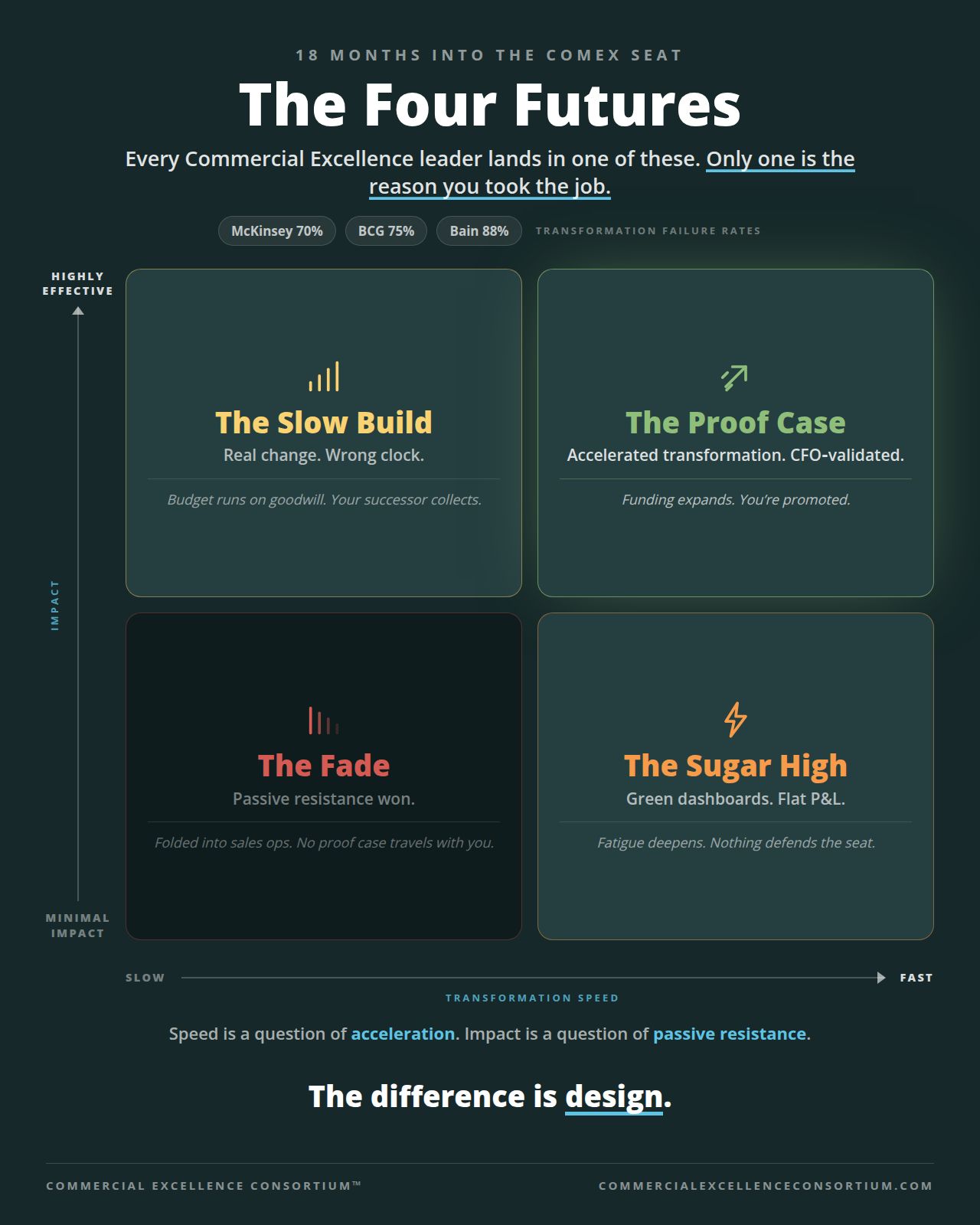
Fast or slow, effective or hollow — the four places a ComEx leader can land 18 months into the seat, and what decides which one you get.
Key Insight
Eighteen months into a Commercial Excellence seat, every leader lands in one of four futures.
I map them on two axes: how fast results become visible, and whether they hold up in the P&L. The first is a question of acceleration. The second is a question of passive resistance — how much of it still stands between the plan and Monday-morning behavior.
• The Sugar High: launches everywhere, feedback is strong, adoption dashboards light up green — and the CFO can't find the difference in the P&L. It's the five-star trainer whose client didn't get in shape.
• The Slow Build: the change is real — capability, behavior, pipeline quality — but you're beating passive resistance by attrition, and proof arrives on your timeline, not the board's. If the clock runs out first, your successor presents the results you built.
• The Fade: no acceleration, no proof. The org folds the function into sales ops, hands the mandate back to consultants, and you leave with tenure on your résumé and no proof case to take into the next room.
• The Proof Case: accelerated transformation inside the patience window, with capability growth you can measure rather than assert. At a €7B specialty chemicals company, that future looked like seven cohorts, 300+ leaders, and adaptive capacity moving a full benchmark band in under 18 months. The leader who built it was promoted. His mandate expanded.
The difference between these four futures is not talent or effort. It is design — passive resistance engineered out, acceleration engineered in.
Which future is your operating model designed to produce?
More one-look frameworks are published to the library as they're finished.
Back to all infographics