Asked why their people hold back, 46 executives from 17 countries named the conditions around them more often than the people, and Dr. Paul Stoltz, creator of AQ®, brought the science of how people respond when the work gets hard.
Executives from these 37 companiestook part in the roundtable
Forty-six executives from 17 countries took part, from medical technology, pharma, chemicals, food ingredients, consumer goods, logistics and industrial technology. Most lead commercial excellence, strategy or transformation. Dr. Paul Stoltz, creator of AQ®, led the session and Jesse Hopps hosted it.
Executives
46
Countries
17
Companies
37
Companies whose executives took part: ABB, Abbott, ADM, AkzoNobel, Archroma, Bekaert, Better Care, Boehringer Ingelheim, Brenntag, Coca-Cola, Covestro, CWS, DHL, Dow, dsm-firmenich, Duni Group, EssilorLuxottica, FORVIA, Georg Fischer, Grifols, Hanseatic Global Terminals, Integrated Diagnostic Services, Johnson & Johnson, Lactalis, LinkedIn, Medtronic, Philips, Plaskolite, Quaker Houghton, Smith+Nephew, Solvay, Stäubli, Sulzer, TE Connectivity, Unilever, Van de Velde, ViiV Healthcare.
Logos show where the executives who took part work today. Taking part is personal: it is not a company endorsement or a client relationship.
02 · The short version
Ask one question, then build six conditions
Ask first
What may be getting in the way?
Ask the people doing the work before you ask them to own more. The answer may be the conditions around them, or what is theirs to change.
Creator of AQ® · Founder and CEO of PEAK Learning
One of the world’s leading scientists and experts studying ownership in human beings, and how the CORE response, part of AQ®, predicts and improves it in adversity, in uncertainty and through change.
People measured for AQ® across 137 countries
5 million+
Languages for his five international bestsellers
17
Harvard Business School adopted his AQ® tools
The conditions leaders set
Jesse Hopps
Founder, Philosopher, Author, Coach
His work is how large enterprises build the conditions in which people take ownership. The point of view in this piece is his: conditions before people, pull before push.
Companies in 108 countries use Demand Metric, founded in 2006
6,589
Senior executives in the Consortium he founded
Nearly500
Architect of TransformationOS™; writing The Transformation Architect
AQ®, GRIT™ and CORE are frameworks and IP from PEAK Learning.
04 · The stakes
Ownership is worth a great deal.Executives rated it at about 6.5 out of 10.
Dr. Stoltz asked for a number first.
Figure 1
On a scale of 1 to 10: where executives put it, 6.5; the move Dr. Stoltz asked them to value, 8.5.
6.5out of 10
How executives rated their people’s overall daily ownership toward what they are trying to do.
▶
6.58.5
12345678910
1 · “utterly pathetic”
10 · “the best it can be”
The ends of the scale are Dr. Stoltz’s words.
6.5 Where executives put it
8.5 The move Dr. Stoltz asked them to value
Asked what moving it from 6.5 to 8.5 out of 10 would be worth to their enterprise, executives answered from hundreds of millions to billions of dollars. The percentages Dr. Stoltz read out ran from 20 to 70.
“We know that cumulatively on this call right now, this meeting right now, hundreds of billions of dollars are at stake in moving that needle.”
Dr. Paul Stoltz
05 · Where to look first
Executives named the conditions around peoplemore often than they named the people
Dr. Stoltz asked the question below. These are the five reasons executives gave most often.
Figure 2
of 28 executives
“Why are they not demonstrating full ownership?”
Unclear direction, roles or vision9 of 28 executives
Conflicting goals, incentives and rewards7 of 28 executives
Fear of failure and low psychological safety6 of 28 executives
Shifting priorities5 of 28 executives
Leaders who control too much5 of 28 executives
In their words
“never seen the north star”
VP of Growth and Product Strategy · plastics
“leadership direction and change not connected or translated lower into real life”
Head of Data, Analytics and AI · pharma
“Environment: leadership penalizing mistakes”
Commercial Execution Leader, Latin America and Canada · diagnostics
“incentives reward other behavior”
Former Head of PMO and Strategic Projects · pharma
The other side
Conditions are not the whole answer. One executive argued that part of it sits with the people.
“I think it’s maybe a lack of looking at themselves, take ownership and feel the ownership and act on it.”
Former P&L owner, engineering thermoplastics · plastics
An honest diagnosis can conclude that individual behavior needs to change.
06 · The science · Dr. Stoltz’s research
How people respond to adversitypredicts how much ownership they take
Dr. Stoltz asked whether their competitors face the same list. Nearly all said yes.
“If you and your competitors are dealing with essentially the same stuff, is it fair to say that those who deal with that stuff better and faster win?”
Dr. Paul Stoltz
His research is about what decides that: how people respond when the work gets hard. He started by taking intelligence off the table.
“IQ predicts next to nothing, beyond slightly above average.”
Dr. Paul Stoltz
He said AQ® predicts what IQ does not: career success, happiness, and how long and how well people live. It measures a person’s hardwired patterns of response to adversity, the setbacks, frustrations and obstacles that make up a normal day. Dr. Stoltz measures that response in four dimensions, known as CORE. They are the four parts of AQ®(Adversity Quotient®).
C
Control
How much you believe you can influence what happens next.
O
OwnershipThe part this page is about
How likely you are to step up and make it better.
R
Reach
How far a setback spreads into everything else.
E
Endurance
How long you expect it to last.
“High AQ® people naturally step up. And lower AQ® people tend to step back.”
Dr. Paul Stoltz
It predicts ownership
In Dr. Stoltz’s research, the CORE response predicts people’s ownership in adversity, in uncertainty and through change.
People can strengthen it
Leaders can measure it, and people can strengthen it at any age.
Control and ownership feed each other, Dr. Stoltz says: the more people believe they can influence, the more they step up. When people feel they can influence very little, they can learn to be helpless, and he said that spreads from person to person. One executive wrote the same loop in three sentences.
“Focus on what is in your circle of control. And the circle will grow. Also works the other way around unfortunately.”
Sales Operations Leader · medical technology
Then he asked the question that makes it a business issue.
“What do your customers care about more? How your people, how your organization shows up when everything’s going fine? Or how they show up when something goes wrong?”
Dr. Paul Stoltz
07 · The practices
Six practices build the conditions for ownership
Each practice is a condition a leader can set for one team. Each comes with why it works, what executives said and one move to try this week.
Practice 1 of 6
Involve people in the why.Set the targets with the team.
Why it works
People who helped shape the why have a reason to follow it. Dr. Stoltz’s point is the gap in practice: leaders spend much of their energy on rewards and incentives, and far less on growing motivation from the inside. Jesse Hopps put it in one line.
“We usually do the opposite - carrots and sticks”
Jesse Hopps
What executives said
“I think it works extremely well when people are involved in the why. So you know that it’s not only the company mission, vision, those kind of things, but that it’s, you know, together with the team, translated into something that’s meaningful for the work group, basically.”
Senior Director, Customer and Commercial Excellence · medical technology
“most people hate most change THEY don't choose”
Former Head of PMO and Strategic Projects · pharma
27 of 27
executives said intrinsic motivation matters more than extrinsic for the ownership they want
Practice 2 of 6
Hold the outcome steady.Hand over the how.
Why it works
Control over method is what most people want back. In Dr. Stoltz’s research, the more people believe they can influence what happens next, the more they step up. Shifting priorities and KPIs take that belief away.
What executives said
“What they like to control is how to achieve. … We don’t want to micromanage them, so we keep telling them this is what we expect them to achieve. But how to get there, we want them to take ownership of how to do things.”
Global Head of Commercial Excellence · chemicals distribution
Asked what they want people to own, executives pointed away from tasks.
“Own outcomes; connection to joint strategy”
Business transformation leader · pharma
“End to End, and go beyond the functional silo”
Supply chain and transformation executive · between roles
“Be prepared to potentially deprioritize their patch for the benefit of the whole organization”
Former Head of PMO and Strategic Projects · pharma
16 of 26
executives want people to own outcomes, results or impact, not tasks
Practice 3 of 6
Set the size of the playgroundwith context and guardrails
Why it works
A clear limit lets people act inside it without asking permission. Jesse Hopps’s view is that structure and freedom work together: leaders define the direction and the boundaries, and people get real room to find the way inside them.
What executives said
“…guardrails that give people clarity on … how their playground looks like, and what the size of that is.”
Business transformation leader · pharma
Two executives described the opposite: leaders who decide everything, and people who wait.
“The original owners were very much, this is how we do things, so they’d walk out on the plant floor, this is what we do, and so people would wait.”
VP of Growth and Product Strategy · plastics
“Learned helplessness happens easily with leaders with long tenures and knowledge -> time tellers and not clockbuilders-> telling more than listening -> micromanagement”
Group Vice President, Business Transformation · industrial technology
5 of 28
executives named leaders who control too much as a reason people hold back
Practice 4 of 6
Show people their work mattersand that someone is paying attention
Why it works
Dr. Stoltz calls it mattering. People who can see what their work changed have a reason to step up again.
“We have to believe that who we are and what we do makes a difference in some way.”
Dr. Paul Stoltz
“If you’re asking people to take ownership, how important is it that people perceive that their ownership will matter?”
Dr. Paul Stoltz
What executives said
“If you also show that what they do matters and there is someone paying attention, that also creates engagement and ownership.”
Senior Director, Commercial Planning · medical devices
Another executive said a vision can be clear and engaging while people still lack the view of how they personally affect it.
Practice 5 of 6
Make it safe to try and to fail.Safe is not the same as comfortable.
Why it works
Freedom to try something new has to come with freedom to fail. Dr. Stoltz adds the other half: comfort wears ownership down. In a sealed biosphere with perfect soil and a controlled climate, many of the trees died. They had no wind. So make the stretch safe, and keep the stretch.
What executives said
“AI simulations and coaching has proved to be a great safe place for our leaders to try, fail and learn”
Group Vice President, Business Transformation · industrial technology
Another executive tied it to the way leaders design change.
“Context matters a lot, as well as putting things in perspective. Not many like to change; but almost everybody likes to learn. Which is also change. So change weariness.. might it be about incorporating learning into change design?”
Business transformation leader · pharma
6 of 28
executives named fear of failure and low psychological safety as a reason people hold back
Practice 6 of 6
Go first as the leader.Then clear what is in the way.
Why it works
Dr. Stoltz asks leaders to meet the standard they set. Permission alone leaves the obstacles in place. The organization has to make ownership easy, not only ask for more effort.
“First of all, as leaders, how dare we? How dare we expect any greater ownership of our people than we demonstrate ourselves?”
Dr. Paul Stoltz
What executives said
“as a leader it starts with you - if you show ownership, you encourage others to follow”
Senior Director, growth platform · chemicals
The same executive added that giving a team permission is not enough. The support you give matters as much.
08 · The tools
Check progress with Dr. Stoltz’s three tools
Each tool is one question to put to a team. What the executives answered gives you a benchmark.
Tool 1 of 3 · Dr. Stoltz’s why and try rating
Rate the why, then rate the try.Act on the gap between them.
How to run it
1
Ask each person: “On a scale of one to ten, how strong is your why?”
Ask for people’s own answer, not the leader’s. The why is the reason people have to try.
2
Then ask for the try
Dr. Stoltz’s words for the top of that scale: “Ten’s like the hardest you’ve ever tried at anything.”
“Without the why, there is no try.”
Dr. Paul Stoltz
His example: a nonprofit team protecting the Grand Canyon rated its why at 10, 12 and 13, off the top of the scale, and its try at about 2.5 out of 10.
The benchmark
Figure 3
On a scale of 1 to 10: their people’s why, out of 10, 7.0; their people’s try, out of 10, 6.0.
7.0
Their people’s why, out of 10
6.0
Their people’s try, out of 10
12345678910
17 of 25
executives rated their people’s try below their why
One executive explained part of the gap.
“Colleagues are more motivated to "Try" if they can operate most within their comfort-zone”
Global Head of Commercial Excellence · chemicals distribution
The why and try rating is Dr. Stoltz’s and PEAK Learning’s tool.
Tool 2 of 3 · Dr. Stoltz’s adversity pyramid
Ask what your people do firstwhen something goes wrong
Dr. Stoltz’s pyramid has five responses to adversity. Ask which one your people reach for first, in the moment something goes wrong, not what they do eventually. Then track the answer the way you track any capability.
The benchmark
Figure 4
of 18 executives
“What is your people’s first response when something goes wrong?”
13 of 18
executives said their people cope first
HarnessTurn the adversity into fuel that takes you somewhere you would not have reached without it.0of 18
ManageApply a problem-solving method. Most change management sits here.4of 18
CopeKeep your head above water, again and again.13of 18
SurviveThe setback hits and you are still here. Now you have to decide what is next.
AvoidDo not answer the email. Say yes and mean no.0of 18
One executive said both cope and manage.
“We know we can’t cope our way to greatness.”
Dr. Paul Stoltz
Then he described the people at the top of the pyramid.
“At the top, people don’t do it better. They do something different.”
Dr. Paul Stoltz
Asked how those people respond to change, executives described a different relationship with it.
“Harnessing is the true catalyst to transformation”
Senior Director, growth platform · chemicals
“Shifting to Harness turns adversity into fuel—accelerating root-cause discovery, driving better solutions, and inspiring natural ownership of execution and outcomes”
Commercial Execution Leader, Latin America and Canada · diagnostics
“Okay, how we can all benefit out of it. What’s the win-win? And what exactly we need to change in our mindset?”
Global Program Manager, Commercial Excellence · specialty chemicals
The adversity pyramid is Dr. Stoltz’s and PEAK Learning’s.
Tool 3 of 3 · The four parts of AQ®
Ask the four CORE questionsto see where a team may get stuck
The four questions
C
Control
How much do we believe we can influence what happens next?
O
Ownership
How likely are we to step up and make it better?
R
Reach
How far does a setback spread into everything else?
E
Endurance
How long do we expect it to last?
How to use it
Ask a team which of the four is strongest, which is weakest, and why. One executive named control and ownership as the strongest pair. Another named control and reach as the weakest.
The benchmark
Figure 5
On a scale of 1 to 10: where executives put their people, 5.7.
5.7out of 10
How executives rated their people’s overall AQ® in the moment adversity hits
5.7
12345678910
1 · “crushed by it the moment it pops up”
10 · “dance through adversity and fire it up”
The ends of the scale are Dr. Stoltz’s words.
To measure it, start with the AQ® profile, which takes about five minutes. The GRIT™ gauge goes with it.
“The question is, can we shift the curve? How quickly can we get medium AQ® people to medium high and medium high to high?”
Jesse Hopps
09 · What changes
Executives expect a stronger responseto show up as initiative, speed and new ideas
Dr. Stoltz asked how it would show up if the average AQ® in their organization went from about 6 to 9 out of 10. Executives answered in a line each.
“… ownership would go up. And I think a big part of ownership is that people take initiative for a couple of reasons. One, they want to do it more. Two, they have permission to do it more, but also the people around them do it more as well.”
Former Head of PMO and Strategic Projects · pharma
“More action without asking for permission”
Former Head of PMO and Strategic Projects · pharma
“Speed to market increased”
Sales Excellence Director · food ingredients
“less coordination, more initiative”
Head of Commercial Excellence · industrial connectors
“encouraged entrepreneurship and more innovative ideas that can differentiate us from competition”
Senior Director, growth platform · chemicals
“better creativity”
VP of Growth and Product Strategy · plastics
“positive outlook, focus on opportunities rather than issues”
Senior Director, Customer and Commercial Excellence · medical technology
“making things different”
Global Commercial Excellence Manager · medical devices
“Increased ownership”
Executive Director, Global Marketing · pharma
Dr. Stoltz put the stakes as a question.
“What if you can create a higher AQ® culture? What just happened to the engine of growth and to recruiting and retaining your best people?”
Dr. Paul Stoltz
Jesse Hopps tied it to everything else a company invests in.
“That’s what’s going to be the denominator across all the other investments going on in technology, training, strategy, vision, all that stuff is divided by how people interpret and then respond to the adversity.”
Jesse Hopps
10 · The playbook on one page
Practices to apply immediately
Ask what may be getting in the way before you ask people to own more. Executives named unclear direction, conflicting rewards, fear of failure, shifting priorities and leaders who control too much more often than they named the people.
Involve people in the why. Take one goal that leadership handed you, ask the team what it means for their work and set the target together.
Hold the outcome steady and hand over the how. State the outcome you need, let the team own how to reach it and keep the priorities few.
Set the size of the playground. Tell one team what they can decide, how far it reaches and what is off limits.
Show people their work matters and that someone is paying attention. Recognize one good idea, practice or experiment where it happened, and say what it changed.
Make it safe to try and to fail, and keep the stretch. Say the rule out loud: fail fast, learn fast, correct course. Then give one team a low-stakes place to practice.
Go first as the leader, then clear what is in the way. Ask your team what sits between them and action, and remove one thing this week.
Check progress with three tools. Rate the why and the try, ask what your people do first when something goes wrong, and ask the four CORE questions. To measure it, start with the AQ® profile.
11 · Where the practices come from
The practices come from executivesaround the world and across industries
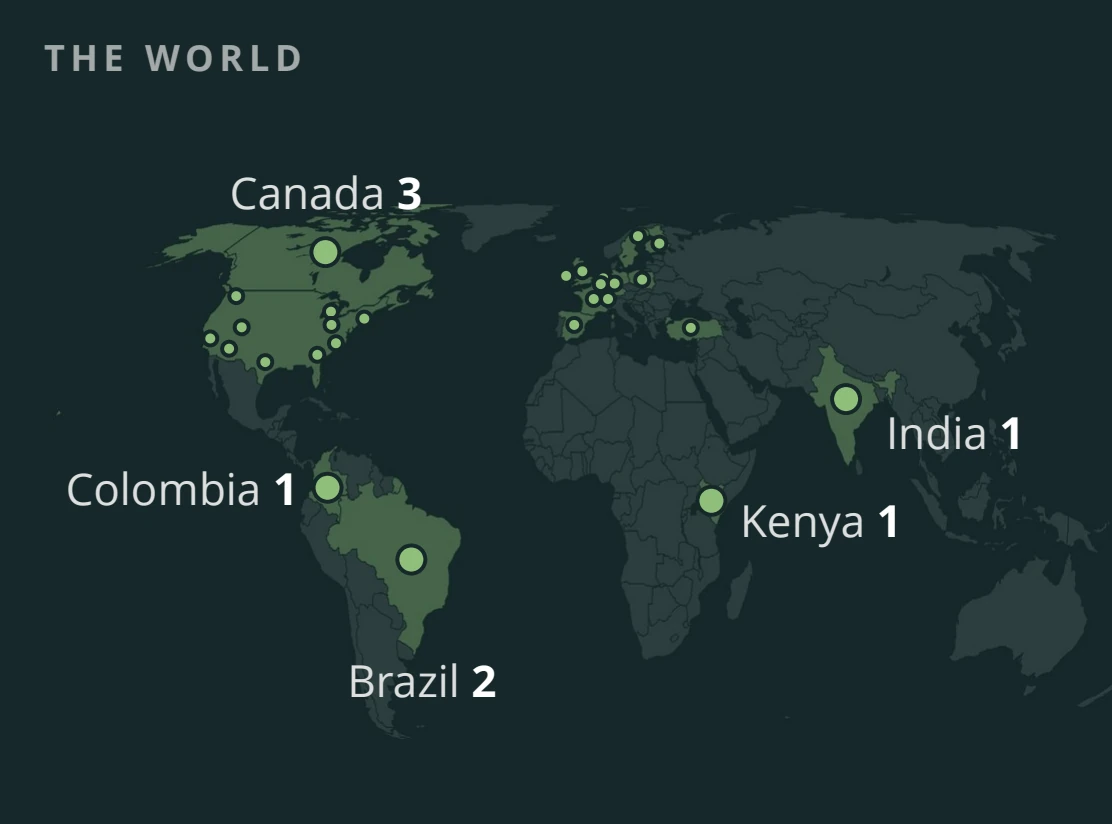
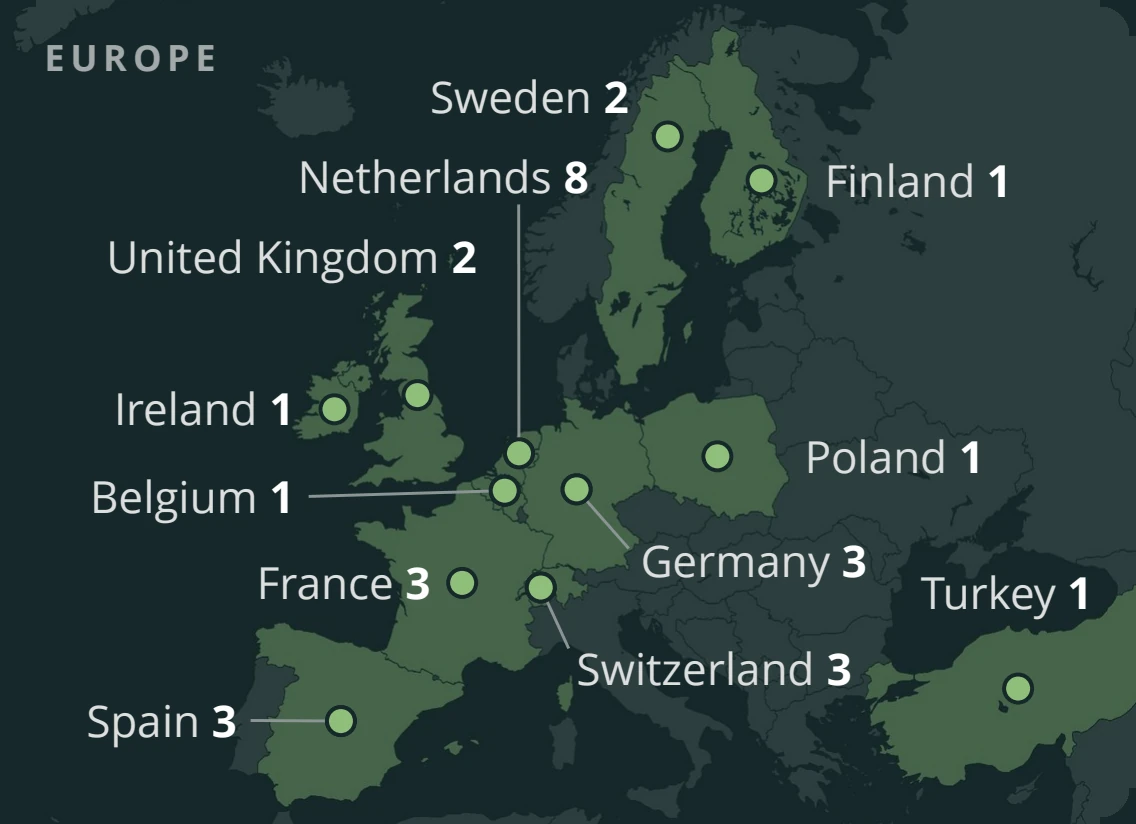
49 people joined from 18 countries: 46 executives, the host, the guest expert and the operator coach.
People
49
Countries
18
US states
10
Countries
United States 12
Netherlands 8
Canada 3
France 3
Germany 3
Spain 3
Switzerland 3
Brazil 2
Sweden 2
United Kingdom 2
Belgium 1
Colombia 1
Finland 1
India 1
Ireland 1
Kenya 1
Poland 1
Turkey 1
US states
Michigan 2
Texas 2
Arizona 1
California 1
Connecticut 1
Georgia 1
North Carolina 1
Ohio 1
Utah 1
Washington 1
Industries
Medical technology and diagnostics10
Chemicals and materials9
Pharma7
Consumer goods and food7
Industrial technology and manufacturing7
Food ingredients2
Logistics2
Services and technology2
Functions
Commercial and sales excellence15
Transformation8
Strategy5
Sales leadership4
Pricing3
Marketing3
General management3
Data, AI and IT2
Other3
Pins show everyone on the call by country, and by state in the United States.
12 · Across a large enterprise
TransformationOS™
Build these conditionsacross the whole enterprise
The practices on this page are conditions one leader can set for one team. A large enterprise has to build them across many teams, and keep them.
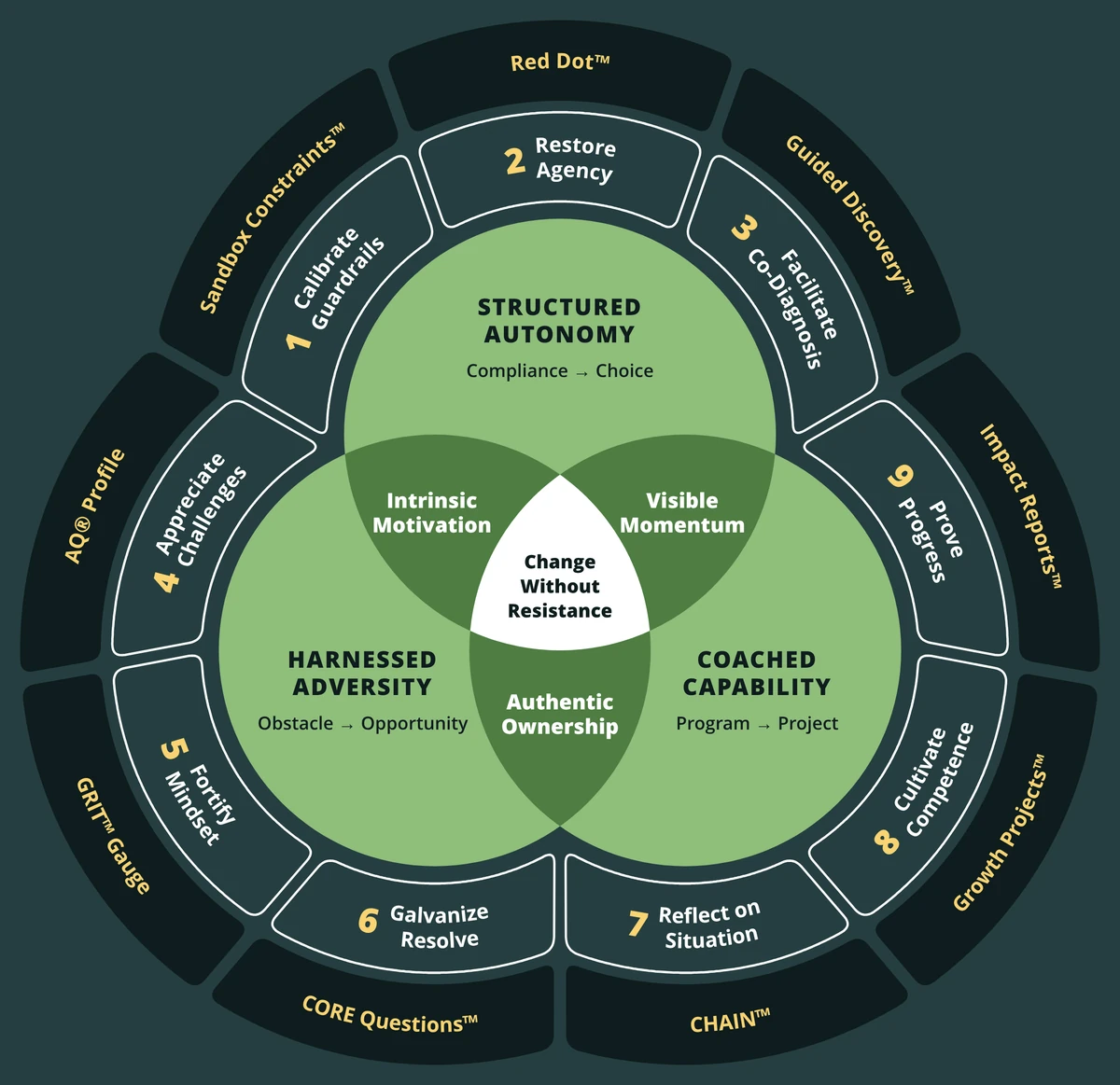
Thousands of people have to willingly change how they think and work while the business keeps running. TransformationOS™ is the system we built for that problem.
On its page the map is interactive: tap or hover any lever, outcome, accelerator or mechanism for a short explanation.
The model: three levers, three outcomes, nine accelerators and the mechanism behind each. Its architect is Jesse Hopps.
Jesse Hopps announced what comes next.
“I’ve been working on this idea of taking this group and getting the top, most inspired, engaged people together to work on building a new approach to transformation and growth inside their organization.”
Jesse Hopps
13 · The Executive Fellowship Program
Apply to jointhe Fellowship
The Fellowship is where you build the plan to do this in your own organization: eight weeks, in a cohort of 20 senior leaders.
Executives in the session rated their people’s overall daily ownership at about 6.5 out of 10. Dr. Paul Stoltz described the scale as 1 for utterly pathetic and 10 for the best it can be. Dr. Stoltz then asked what moving that number from 6.5 to 8.5 out of 10 would be worth to their enterprise. Answers ran from hundreds of millions to billions of dollars and from 20 to 70 percent, and he said that across the executives on the call, hundreds of billions of dollars are at stake.
Why do employees not take full ownership of their work?
Executives named conditions more often than people. Of 28, nine named unclear direction, roles, or vision; seven conflicting goals, incentives, and rewards; six fear of failure and low psychological safety; five shifting priorities; five leadership control. One argued part of it is people not looking at themselves. Dr. Paul Stoltz noted that competitors’ people face the same list, so the ones who deal with it better and faster win.
What do executives want their people to own?
Asked in one sentence, 16 of 26 executives answered with outcomes, results, or impact rather than tasks. Others named going end to end beyond the silo (5), growth and new ideas (4), customers (4), accountability and decisions (3), and a link to strategy (2). One executive said ownership can mean being ready to put your own patch second for the benefit of the whole organization.
Is intrinsic or extrinsic motivation more important for ownership?
Intrinsic: 27 of 27 executives said so. Dr. Stoltz’s point was the gap in practice: leaders spend much of their energy on extrinsic motivation, such as rewards and incentives, and far less on growing it from the inside. The host added that organizations usually do the opposite, with carrots and sticks. The why and try rating is the tool Dr. Stoltz uses to check it.
What is the why and try tool?
Ask a team to rate, on a scale of 1 to 10, how strong their why is, then how strong their try is, meaning the effort, where 10 is the hardest you have ever tried at anything. A try stronger than the why cannot last and ends in burnout. A why stronger than the try gives no progress. Dr. Stoltz described a charity team working to protect the Grand Canyon whose why answers were 10, 12, and 13, off the top of the scale, and whose try averaged about 2.5 out of 10. The executives rated their own people at 7.0 out of 10 for the why and 6.0 out of 10 for the try.
What is AQ®?
Dr. Stoltz, who created it, defines AQ® as a measure of a person’s hardwired patterns of response to adversity. He said it has been measured in more than five million people across 137 countries. It rests on four parts: control, ownership, reach, and endurance. Asked to rate their people’s overall AQ® on a scale of 1 to 10, where 10 is people who dance through adversity and 1 is people who are crushed by it the moment it appears, executives rated them 5.7 out of 10 on average. The AQ® assessment itself is scored on a 200-point scale.
What are the four parts of AQ®?
Control asks how much you believe you can influence what happens next. Ownership asks how likely you are to step up and make it better. Reach asks how far a setback spreads into everything else. Endurance asks how long you expect it to last. Dr. Stoltz said high-AQ® people step up and low-AQ® people step back. One executive named control and ownership as the strongest in their organization; another named control and reach as the weakest.
How do most teams respond when adversity hits?
They cope. Asked for their people’s first response, 13 of 18 executives said cope, 4 said manage, and 1 said both. None said avoid and none said harness. Dr. Stoltz’s view is that coping keeps your head above water and that nobody copes their way to greatness. Harnessing, in his words, turns adversity into fuel that takes you somewhere you would not have reached without it.
How do you give people ownership when priorities keep changing?
Executives said the loss of control comes from shifting priorities and KPIs, not from the people. One leader tells teams the outcome and lets them own how to reach it, and said the struggle is that leadership keeps changing priorities. Another said the current focus is to simplify and prioritize: less is more, pick the right priorities. A third added that it is better to do 3 things well than 7 things badly.
What helps a team take more ownership?
Executives named six practices: involve people in the why and set targets with the team, hold the outcome steady and hand over the how, set the size of the playground with context and guardrails, show that the work matters, make it safe to try and fail, and go first as a leader, then clear the blockers in technology and process. One executive added that giving a team permission is not enough; the support you give matters as much.
Why do people resist change they did not choose?
Executives said people resist change they did not choose or do not fully understand. One suggested the answer sits in design: not many people like to change, but almost everybody likes to learn, which is also change, so change fatigue may be a question of building learning into the change. Another warned that leaders with long tenure and deep knowledge tend to tell more than they listen, which turns into controlling the details.
What would change if your people’s AQ® rose from 6 to 9 out of 10?
Executives answered in a line each: more action without asking permission, speed to market, less back-and-forth and more initiative, better creativity, more teamwork, happier customers and organic growth, and a competitive edge. One said it would solve the key challenges and open the way to growth. Dr. Stoltz said the research ties AQ® to performance, engagement, retention, and innovation.
How can leaders raise ownership by changing how they lead?
Executives said it starts with the leader. If you show ownership, others follow, and giving a team permission is not enough; the support you give matters as much. One said leaders with long tenure and deep knowledge tend to tell more than they listen. Another said freedom to try and freedom to fail come with ownership. A third said AI practice sessions and coaching gave leaders a safe place to try, fail, and learn.
What are the five ways people respond to adversity?
Dr. Stoltz described a pyramid with five levels, from the bottom up: avoid it, survive it, cope with it, manage it, or harness it. Avoiding means not answering the email or saying yes and meaning no. Surviving means you are still here and now have to decide what is next. Coping means keeping your head above water. Managing means applying a problem-solving method, which is where most change management sits. Harnessing means turning the adversity into fuel that takes you somewhere you would not have reached without it. Asked what their people do first, 13 of 18 executives said cope and none said harness.
What does AQ® predict that IQ does not?
Dr. Stoltz said IQ predicts next to nothing beyond slightly above average about career success, happiness, and longevity, and that AQ® predicts them. He said the link to performance is extremely strong, and that the research also ties AQ® to engagement, commitment, retention in high-pressure organizations, and innovation. Executives in the session guessed drive, creativity, optimism, resilience, and a willingness to take risks.
Can AQ® be measured?
Yes. Dr. Stoltz said AQ® is measured on a 200-point scale. After the session, members were offered the AQ® profile, which takes about five minutes, and the GRIT™ gauge. The host described AQ® as the defense and GRIT™ as the offense, and told members to answer how they honestly would respond, not how they wish they would.
Want to be in the next session?
Consortium membership is invite-only and reviewed weekly. Directors and VPs of Commercial Excellence, Strategy, and Transformation at $1B+ enterprises.
No consultants, SaaS vendors, or service providers.